
MF zoom
Nikon manual focus zoom lenses
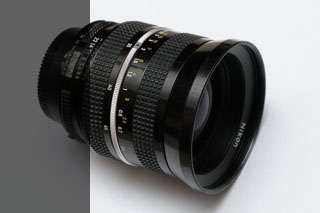
AI 28-45mm 4.5
The world’s first mass produced 28mm zoom to hit the market was offered by Nikon in 1975 in form of this pro-grade lens. Between 1975 and 1978 around 21.000 lenses were produced. Price: Germany (1979): 1049 DM, inlfation adjusted 2012: 1125 €.
Despite the excellent build quality, zoom and focus ring move more freely than expected. This does not mean that the lens has a sloppy feel in any way, but it comes as a surprise. 72mm filter size became an additional standard in the Nikon system during the following years.
As always with technological breakthroughs the first version is OK enough, but not as good as later, refined lenses. In my opinion this sums up the overall performance. All core aspects are OK, but not great. Sharpness is good already wide open in the center of the frame at all focal lengths, edges suffer from field curvature at wider settings. On 36 MP a drop in sharpness can be seen at landscape distances. Distortion is a bit above average (barrel type), flare is a big issue overall.
Surprisingly vignetting gets more visible towards the long (!) end. At 28mm the corners are almost acceptable at f/5,6 and unproblematic at f/8. From 40mm and up you need to stop down to f/8 to avoid easily visible darkening.
Performance is impacted at any aperture in bright settigns. As soon as there are bright, direclty lit objects prominently in the frame, the overall sharpness suffers. This behaviour can be seen with many older, optically complex lenses.
From a collector’s perspective this is a very interesting lens as a technical milestone. From a photographer’s point of view this lens is a bit lacking on modern high resolution DSLRs. The 25-50mm is the better option at a slightly higher price. Still, the 28-45 is a usable lens.
Samples (FX / 36 MP): 28mm f8 45mm f5,6
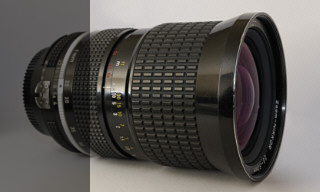
AI 25-50mm 4.0
This lens was produced only for a very short time between 1979 and 1985, approximately 28.000 lenses were made. Price: US (1985): 760 $, Germany (1981): 1050 DM, inlfation adjusted 2012: 985 €.
This lens was very expensive during it’s short lifetime and probably didn’t sell well. Professional photographers were still completely focused on fix-focal lenses and amateurs could not afford this lens. After Nikon stopped the production it was sold off for half the price. It is a massive construction made to last. With a weight of 600 grams it’s no lightweight either and due to the size and proportions it looks impressive even on a D200. It has a very unusual filter size of 72mm and make sure to get the very rare HK-7 hood or a longer replacement (see below) with it.
The optical performance is outstanding if you understand the strong and weak points of this lens. First of all the technical data alone would not cause excitement today. The lens is not very fast and the zoom range is rather limited, due to DX digital the lens is not even a wide angle any more.
Performance on DX: Sharpness is only average at f/4, but it sharpens up well in post processing. When stopped down to f/5.6 things improve dramatically, sharpness is even across the frame and into the corners. On the wide end optimal results are achieved from f/8 on, at the 50mm end peak performance is already achieved by f/5.6. In the wide position the focus indicator of the D200 is no help because the green dot stays on for a very long focusing range. Due to the relatively slow aperture manual focus at the wide end therefore can be very tricky.
CA is extremely low to even non-existing and distortion is very low. The lens suffers from some moderate flare and ghosting, but you can work around it. Flare improves towards the long end, from 35mm on it should not be a big problem any more because the lens moves backwards in the outer lens barrel. On DX cameras you can try to use a longer hood to minimize flare problems. I successfully tried a HN-20 hood which is originally intended to be used with the 85mm 1,4 Nikkor. On a FX body the hood vignettes from 25mm to 38mm, on digital no vignetting is visible from the wide setting at 25mm on when the hood is used without any filter.
Performance on 12MP FX: Center sharpness is as with DX bodies very good already at f/5.6. Corner sharpness varies depending on focal length. From 25mm to 35mm the lens needs to be stopped down to f/8 to achieve acceptable corner sharpness. From 35mm to 50mm the corners are acceptable already at f/5.6 and perfect at f/8.
My personal conclusion with this lens is that it is certainly one of the best manual focus lenses around and it certainly is the best manual focus wide angle zoom from Nikon which holds up well compared to modern lenses. Why? Because the lens produces a look that is hard to describe. Stopped down to f/5.6 or below this lens simply “rocks” and produces pictures that have a “3D-look” and simply jump off the screen. When you know how to work around it’s limitations this lens is as good as it can be in it’s range. I would not recommend to use this lens for portrait photography, the need to stop down to at least f/5.6 puts it right into the landscape-shooting category.
The lens is very rare in the used market and I would recommend everybody interested in this range to buy one if there is a copy available. Due to the limited availability prices vary a lot.
Samples (DX / 10 MP): 25mm f8 25mm f11
Samples (FX / 12MP): 25mm f11
Samples (FX / 36MP): 25mm f4 25mm f8
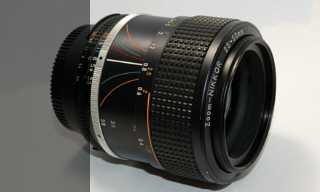
AI-S 28-50mm 3.5
A rare lens with an unusual focal length coupled with relatively fast speed packed in a very compact package. Production lasted only from 1984 to 1985 with a total production of 21.000 lenses. Price: US (1985): 388 $, Germany (1984): 619 DM, inflation adjusted 2012: 522 €.
Optical perfomance on DX is very good after stoppng down to f/5.6. The zoom range is very limited but the very small size and the weight of only 395g may be more important in some applications. You can read more about this lens in my lens comparison of the early wideangle zooms.
If you are looking for a very compact lens with very good performance on DX this one it highly recommended. The tricky part will be to find one for a reasonable price. Due to the fact that is offered very seldom prices vary a lot. On ebay it should sell for 100 to 150 Euro in good condition. Some sellers might want a premium simply because it’s rare, a seller once offered me a nice sample for 240 Euro with the main argument being it’s collecters item status.
Samples (DX / 10 MP): 50mm f5,6 28mm f8
Samples (FX / 36 MP): 28mm f/5,6
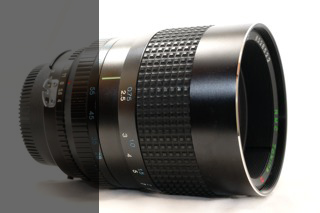
Tokina 28-85 4,0
Zoom lenses from the manual focus era are often associated with optical compromises. This can be understood in the light of the big improvements that optical design has made from the end of the eighties throughout the nineties.
However, several very nice performing zoom lenses are available between 25mm and 200mm from Nikon that still perform to high standards – even today. In the wide area of non-OEM lenses the situation gets a bit more difficult.
Third party manufacturers needed to be cheaper than the camera brands and therefore optical and – sometimes – mechanical quality had to be sacrificed.
Tele zoom lenses reached a very high quality level early on, while wide angle and normal range lenses showed more often optical limitations. Therefore it is not easy to pick the few magnificent third party wide to normal zoom lenses amongst the wide offering that is available in the used market today.
Tokina always build lenses to a very high mechanical standard. This also holds true for the 1977 introduced 28-85mm 4,0 lens. The construction is very sturdy and the weight of more than 500 grams creates the impression of stability. Focus and zoom ring are very well damped and operate smoothly.
The focus ring moves in the opposite direction that is found on Nikon lenses. This creates a big confusion with focus direction indication: you have to turn the lens in the opposite direction than indicated in the viewfinder.
Regarding the optical quality, this lens has highs and lows. Overall, center resolution and color rendering are very good regardless of focal length, even on the D800. Sharpness is already quite good in the middle at f/4 and very good at f/5,6 across the focal range. The big issue is corner sharpness and – more so – vignetting. At 28mm the corners never get exactly sharp, from around 50mm an aperture of f/8 delivers good performance across the frame.
Vignetting never disappears up to 50mm, after that you have to stop down to f/8 to get rid of it. This is really a pity, because the lens delivers a very nice performance from the rendering perspective. Pictures come out with nice color and contrast and very good sharpness in the center, even on the demanding D800 sensor. On the D700 things become a bit easier regarding corner sharpness, nevertheless above mentioned negative aspects sill hold true.
Overall I quite like the lens, but somehow it has limited use on the D800. On bodies with less resolution good results can be achieved from 35mm and up, where corners should become acceptable. Alternatively, this lens is a good choice for a manual focus on a DX body. Making use of only the center portion of the frame turn this lens into an excellent performer.
Samples (FX / 36 MP): 28mm f8 50mm f5,6
AI and AI-S 35-70mm 3.5
The professional’s standard-zoom in the 80’s and the ancestor of the 2,8-zooms that followed (AF 35-70 and 28-70). This lens was offered as AI and AI-S Version, both differ in appearance and optical construction. The differences in optical performance described below are present but keep in mind that it is not a night-and-day difference.
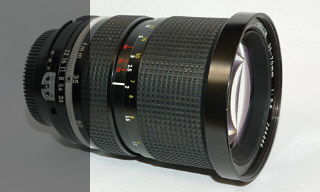
AI 35-70mm 3.5 (72mm)
The first version of the 35-70mm 3,5 lens appeared in 1977 and was replaced by the AI-S version in 1981. Production of 50.000 lenses. Price: US (-): -, Germany (1981): 950 DM, inflation adjusted 2012: 861 €.
Optical performance is a bit better than with the later 62mm version, but not by much. Contrast and resolution are a bit better and the lens delivers an overall nice picture rendition with very good colors. Sharpness is good even wide open, very good at f/5,6 and excellent at f/8.
The biggest problem of this lens is flare. I was quite surprised to find flare so problematic as this is no real wide angle lens. Make sure to always use a lens hood, on DX the HN-20 works perfectly and reduces the flare problem so much that it is no problem any more.
Samples (DX / 10 MP): 70mm f5,6 35mm f8
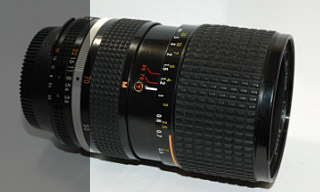
AI-S 35-70mm 3.5 (62mm)
With the switch to AI-S the 35-70mm gets a major update with a new optical formula and a slimmer filter size of 62mm. Total production of 160.000 lenses. Price: US (-): 675 $, Germany (1981): 1150 DM, inflation adjusted 2012: 1079 €.
This lens is the version with the 62mm filter thread that followed the earlier 72mm version. It is very well made, it’s construction is really outstanding. Take off the rear lens cap and have a look at the internal fabric-coated dual-cam contruction that slides in and out around the rear lens group while zooming and you will understand what I mean.
For the first time a Nikon zoom lens offers a macro setting, doing so at 70mm is quite useful.
I would rate the optical performance as good. The lens produces nice pictures with good colors, overall a good performer. Flare is not a problem as it is with it’s predecessor.
Sample (DX / 10 MP): 40mm f/4
Samples (FX / 36 MP): 35mm f/3,5 35mm f/5,6
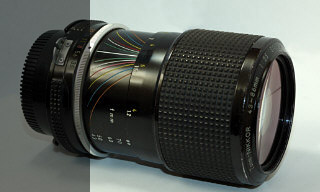
AI-S 43-86mm 3.5
The 43-86mm 3.5 marks a milestone in many ways. Introduced in 1963 and in production for more than 18 years, this lens sold over 400.000 times and can be called as one of the most successful consumer zoom lenses of it’s time. The optical construction was changed in 1976, leading to improved performance. The here reviewed lens is the later and improved model.
The mechanical construction is quite nice and very sturdy for a consumer lens. But maybe this point of view has no relevance because back in the days there was no difference between consumer and pro lenses and everything was built to the highest possible standard. The high built quality does not translate to the optical quality. You have to stop the lens down to f/8 to get anything decent and even then the pictures leave something to be desired. The lens takes pictures that are just OK at apertures of f/8 to f/11 but almost all other Nikon lenses will be better.
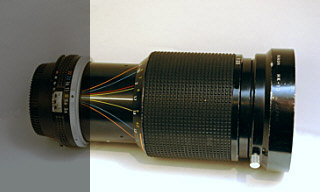
AI-S 50-135mm 3.5
This lens is the perfect partner for the 25-50 4.0 zoom. The lens was introduced in 1982 and production ended already in 1984 with a total production of 30.000 lenses. Price: US (1985): 540 $, Germany (1984): 930 DM, inflation adjusted: 784 €.
Pictures from the 50-135 are hard to distinguish from pictures taken with the 25-50. Both render very good pictures, the 50-135 seems to be a little bit sharper. CA is very visible at f/3.5 and f/4.0 but suddenly disappears by f/5.6. Sharpness at f/3.5 is already excellent, mostly contrast is improved when stopping down to f/5.6. Colors and contrast are very good. Pictures taken with this lens are surprisingly vivid even in difficult light. Highly recommended!
Samples (DX / 10 MP): 50mm f5,6 75mm f4 85mm f8 135mm f8
Samples (FX / 36MP): 50mm f3,5 50mm f5,6 135mm f8
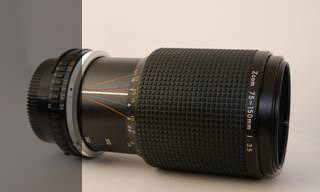
Series E 75-150mm 3.5
This lens is like most E-series lenses available in two different versions. The earlier version has a black plastic ring above the aperture ring, produced between 1979 and 1981, 70.000 units. The second version from 1981 to 1985 has a chrome ring instead of the black plastic. This “remodelling” was done with all Series E lenses that were in production at that time to put their optical appearance more in line with the AI-Nikkor lenses. The chrome ring version has two different serial number ranges. The first batch starts at number 18XXXXX with approximately 35.000 lenses produced, the second batch starts with serial number 30XXXXX with approximately 65.000 lenses made. Price: US (1985): 316 $, Germany (1984): 430 DM, inflation adjusted 2012: 362 €.
The lens is part of the budget Series E line of lenses that Nikon made to attract more consumers to invest in real Nikon lenses instead of buying third party alternatives. They are officially no “Nikkor” lenses, just “Nikon lenses”. The lenses were mostly a cost-cutting exercise. For the first time Nikon used a large amount of plastic on the fix-focal E lenses (Except the 135mm 2.8 lens, this is constructed as good as it gets). The zoom lenses in the E-series were mostly made of metal, and the 75-150 is no exception here. One big drawback is the sloppy push-pull zoom of this lens. Today it is almost impossible to find a 75-150 with a zoom collar that stays in place while turning the lens over, the collar moves freely on most of the used lenses.
I have tested several samples of the black plastic ring and chrome ring lenses. Difference in optical quality comes down to sample variation. The 75-150 is a very good lens. Slightly stopped down to f/4.0 it delivers sharp pictures with a really pleasant background blur. CA is moderate. Saturation and contrast are lower than with modern tele lenses but acceptable. If color rendition and superior contrast are preferred the AI-S 50-135mm is the better choice. The 75-150mm E lens is another light travel alternative to any of the big and bulky 80-200 constant 2,8 zooms. If you can stand the sloppy zoom ring you get an optically very good lens at a bargain.
Sample (DX / 10MP): 150mm f8
Samples (FX / 45 MP) – Updated September 2019: 75mm, f/3,5 75mm, f/5,6 75mm, f/8,0
150mm, f/3,5 150mm, f/5,6 150mm, f/8,0
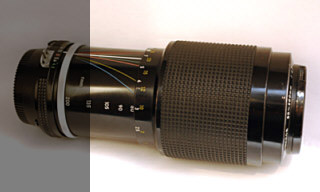
AI 80-200mm 4.5
This lens was the first professional 80-200 zoom from Nikon. It was introduced in 1969 as a lens with 15 elements, it received multicoated elements in 1973 and was shortly produced as AI-Version in 1977. About 140.000 lenses of the 15-element type were made. In late 1977 a new optical design was introduced. The newer lens (with serial numbers starting at 760.000) consisted of only 12 lens elements to reduce flare and ghosting. This lens was replaced by the 80-200 4.0 in 1981 after a production of about 150.000 lenses. Price: US (-): – $, Germany (1981): 990,- DM, inflation adjusted 2012: 929 €
The viewfinder gets relatively dim with this lens. The lens is moderately sharp at 4.5. Stopping down to f/5.6 improves that (better f/8 from 150mm and up) and the lens becomes very sharp with great contrast and color. CA is a little bit more troublesome than with a modern ED-lens but this lens is still capable of very nice pictures with excellent quality. In backlit situations the lens flares easily and there is a loss of contrast. Considering the low price of about 40 to 70 Euro on ebay for mint copies this lens is a steal. Be aware that the focus/zoom collar moves freely and almost without any resistance. This is by design and not dependent on the condition of the lens.
Sample (DX / 10 MP): focal length unknown, f/4,5
Samples (FX / 36 MP): 80mm, f/4,5 80mm, f/5,6 200mm, f/4,5 200mm, f/5,6
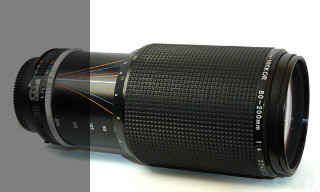
AI-S 80-200mm 4.0
The successor to the 80-200mm 4,5 was produced between 1981 and 1998 with an amount of approximately 160.000 lenses. Price: US (1985): 700 $, Germany (1983): 1180,- DM, inflation adjusted 2012: 1020 €.
The moderate increase of the maximum aperture comes along with an increase of the filter size to 62mm and a little bit more weight compared to the predecessor. The focus/zoom collar is now damped and does not move as freely as on the f/4,5 lens.
Wide open performance is acceptable across the range with a typical slight drop on the long end. Sharpness at f/5,6 and below is very good at any focal length on lower resolution DSLRs. On high resolution bodies the older f/4,5 version is more convincing.
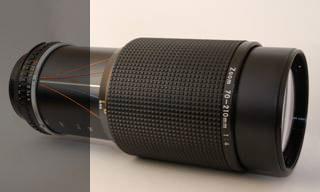
Series E 70-210mm 4,0
Produced between 1981 and 1985 in a quantity of approximately 150.000 units. Price: US (-): -, Germany (1983): 680,- DM, inflation adjusted 2012: 587 €.
The optical formula is identical to the later AF Nikkor of the same range and aperture, the AF Nikkor may have different coating. I was never really impressed with this lens. Sharpness is good but not spectacular and color seems to be on the cool side.
AI-S 100-300mm 5.6
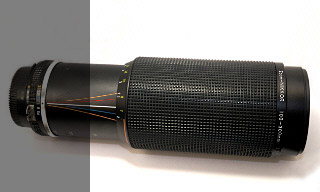
The 100-300 lens is very unusual from today’s perspective with an impressive physical appearance. It can be seen as the predecessor for the recent 70-300mm zooms. Unlike the lenses of this focal range that are sold today this lens offers a high quality metal construction weighting in at an impressive 900 grams. One thing that is very remarkeable about this lens is the length of the lens barrel. It literally dwarfs the 80-200mm 4.5 and is even quite a bit longer than my push-pull 80-200mm 2,8. 60.000 lenses produced since 1984, discontinued in the nineties. Price: US (1985): 420 $, Germany (1984): 750 DM, inflation adjusted 2012: 709 €.
The slow aperture and the length of the lens barrel make this lens difficult to handle, the viewfinder gets dim and the whole camera/lens assembly gets quite front-heavy. The optical quality is average. From 100 to 200mm the lens is sharp even wide open, beyond 200mm f/8 is needed to achieve good results. Don’t be afraid of shutter speeds below 1/320s at 300mm, the lens is quite heavy and therefore not so prone to camera shake. You can get away with 1/200s hand-held at 300mm.
This lens is an ergonomic catastrophy. I would not recommend to hold the camera/lens combo by the camera for a longer time because of the weight of the lens anyways, but if you try you will suffer from sore wrists because the whole setup constantly tries to “nosedive”. Useage on a tripod is problematic without a tripod mount. It is not possible to use the Manfrotto lens cradle or any other tele lens support because the whole barrel is used for the push-pull zoom and the inner barrel rotates while focusing. You simply don’t have a place to attach a lens support.
Is there any reason to own this lens? Well, if you need something to strike down bulgars at night this lens certainly helps due to it’s weight. The aperture is slow and the perfomance falls in tow parts: below and above 200mm. The lens is good at f/5.6 up to 200mm and needs f/8 above. It is an optical decent lens if you can live with the shortcomings in handling.
Sample (DX / 10 MP): 250mm f5,6