
28-45mm 4,5 vs. 25-50mm 4,0 vs. 28-50mm 3,5
Lens comparison: Nikkor 28-45 f/4.5 vs. 25-50 f/4.0 vs. 28-50 f/3.5 – updated 2016 with DX and FX experience.
This lens comparison might sound very unusual and it really is a little bit unusual. The three lenses that I am comparing here don’t have the most exiting technical specifications, one of them can hardly be called a zoom and all of them are not very fast. The fact that there is very little information on the web about any of these lenses made me curious and therefore I decided to compare this set of very rare zoom lenses after hunting them down on ebay. You can also download sample pictures from the 25-50mm and the 28-50mm from my individual lens review pages.
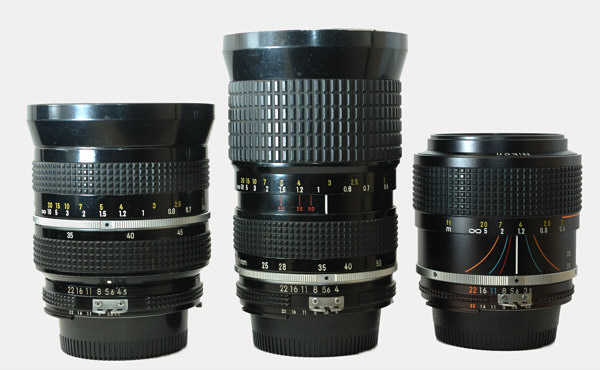
From left to right: 28-45mm / 25-50mm / 28-50mm
The History
These three lenses are successors in chronological order. The 28-45mm 4.5 appeared in 1975 and was the first wide-angle zoom by Nikon and in fact the first wide angle zoom ever that started at a focal length of 28mm. This may not sound exciting today because we are spoiled by the 12-XX or 17-xx zoom offerings that are very common nowadays. In it’s time the 28-45 was a real sensation and a technological breakthrough. It was aimed at the professional market and was produced between 1975 and 1978 with a total production of about 20.000 lenses. Dimensions: length: 91mm diameter: 75mm with 72mm filter ring, Weight: 440g. Two-ring design.
The 25-50mm 4.0 appeared in 1979 and replaced the 28-45mm. It is very bulky, offers more zoom range and speed. Produced between 1979 and 1983 with approximately 27.000 units. Dimensions: length: 112mm diameter: 75mm with 72mm filter ring, Weight: 600g. Two-ring design. The front rotates while focusing.
The 28-50mm 3.5 does not seem to fit in this set. Contrary to the other two lenses it is a push-pull zoom design, it is very small compared to the other two lenses and considerably lighter. From the zoom range it offers and because it was introduced in 1984 it can be concluded that it is the successor to the 25-50. But neither construction, build quality and weight make it a natural successor the older pro-caliber lens. It was half the price of the 25-50 and it was quickly replaced by the now obviously consumer oriented 28-85mm 3.5-4.5 just one year later.
Production ended already after approximately 20.000 lenses. Dimensions: length: 75mm diameter: 68.5mm with 52mm filter ring, Weight: 395g. Push-pull zoom with DOF marks and a macro setting at 50mm.
Testing and experience in using the lenses was collected over the years on D200, D300, D500 (DX), D700 and D800 (FX) .
Optical performance:
28-45mm 4.5:
This lens is sharp enough even wide open on low-res sensors, but it is very difficult to focus this lens in darker environments. Due to the slow wide open aperture the green focus indicator sometimes does not indicate correct focus in these situations.
Overall image quality is good. Sharpness is a little bit lower than with the 28-50mm and the 25-50mm, color and contrast are comparable to but do not reach the high level of the 25-50mm. Not much difference in performance on the long or wide end. Flare is a real problem with this lens and it suffers from a high loss of contrast even in moderately backlit situations. CA is a non-issue.
On high resolution sensors (D500 / D800) the resolution wide open is not sufficient to resolve enough detail any more. Stopping down to f/8 is mandatory. Edges and corners also suffer up to that aperture. Coma around highlights also takes its toll regarding sharpness.
25-50mm 4,0:
Sharpness is only average at f/4 with a little internal flare, but it sharpens up well in post processing. When stopped down to f/5.6 things improve dramatically, sharpness is even across the frame and into the corners on DX. On the wide end optimal results are achieved from f/8 on, at the 50mm end peak performance is already achieved by f/5.6. CA is extremely low to even non-existing and distortion is very low compared to modern zooms.
The lens suffers only from moderate flare and ghosting. Pictures taken with this lens really “pop” and picture quality is outstanding. Perfect landscape lens with great colour and contrast even wide open. The handling of the lens is a bit difficult on a DSLR because of the relatively low speed, you have to be very careful with focusing.
On FX corners between 25mm and 35mm are weak up to f/8. At the widest setting even f/11 does deliver moderate sharpness in the extreme corners of the frame.
28-50mm 3.5:
This lens has different characteristics on DX and FX due to the crop factor.
On DX: Center sharpness is only average at 3,5 but good at f/4.0, excellent at f/5.6. It is a tiny bit sharper at f/4 and f/5.6 compared to the 25-50 4.0 (really not by much), at f/8 the 25-50 f/4.0 is better and remains to be the better lens up to f/16. Color is excellent, contrast wide open is a bit lacking but improves one stop down. On DX the corners of the 28-50 get excellent at f/5,6. It features only moderate CA with a little bit more flare than the 25-50. The macro setting at 50mm is good for a reproduction ratio of 1:5. For high resolution DX sensors the 28-50 does not resolve enough detail overall.
On FX: Image quality towards the edges and corners of the frame does not satisfy entirely at any aperture and focal length. Stopped down to f/11 the optical quality starts to satisfy, however kit lenses are good as that today also. On the D800 overall resolution does not seem to fit to the sensor capabilities.
Conclusion
Depending on the sensor format, either the 28-45mm 4,5 or the 28-50mm 3,5 can be seen as the weakest of the trio. On DX the 28-45mm 4,5 is less attractive due to the limited zoom range. This lens may be of interest for collectors because it was the first zoom ever that started at a focal length of 28mm and therefore marks a technological milestone. If you can live with the limited zoom range and the flare issue, this lens is a good buy if you can find one. Image quality is still good stopped down below f/5,6 compared to modern kit zooms. Coma around highlights might also be a limiting factor as well as lack of resolution on high-res sensors.
The 28-50mm takes the second place on DX in this comparison. If you are looking for a compact zoom lens on DX with very good performance this lens will do the trick. Image quality wise this lens comes very close to the 25-50 except the color rendition. The macro setting might be useful and the easier handling compared to the 25-50mm turns it into a very good general-purpose walk-around lens. On FX however, the usefulness is impacted by the low quality towards the image borders and corners.
The 25-50mm certainly is the best pick with an optical quality that is simply stunning. The complete lack of CA is amazing and the pictures produced with this lens have a quality that is hard to describe. As long as you can live with the varifocal design, it is a very good landscape lens. If you don’t mind the size and weight and you know how to focus correctly this lens is the clear winner of this comparison. On FX corner sharpness is not on the level of a modern lens, but still sufficient.