
AF zoom wide
Nikon, Sigma, Tamron auto focus zooms – ultra-wide
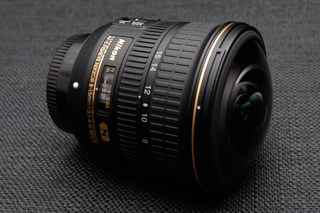
Fisheye AF-S 8-15mm 3,5-4,5 E IF-ED
This new fisheye zoom is the biggest surprise from Nikon in 2017 so far. However, Nikon had some catching up to do. The last Fisheye for FX was the AF-D 16mm 2,8 in 1993 and the also diagonal variant 10.5mm for DX was introduced ten years later. A Fisheye with circular projection for FX is entirely missing in the current lineup.
Build quality and appearance

Nikon 8-15mm 3,5-4,5 and Sigma 15mm 2,8
With just a bit more than 480g the lens is rather lightweight and compact in appearance. Quality of construction creates a solid feeling, but lacks a bit compared to the big professional zooms like the 24-70mm 2,8.Rather unusual is the configuration of front cap and lens hood.
The front cap (LC-K102) is formed like a hood that grabs inside the lens hood (HB-80) when mounted. The hood itself features a button to detach it from the lens, which is necessary on FX below 14mm, otherwise the inside of the hood makes up most of the picture.
The front cap has spaces at the side to operate the button even when the cap is mounted.Hood and cap are a bit on the flimsy side. This is not critical, but in the past Nikon accessories in this department were more solid. At the rear of the lens there is a holder for gel filters, a feature what seemed to be extinct.
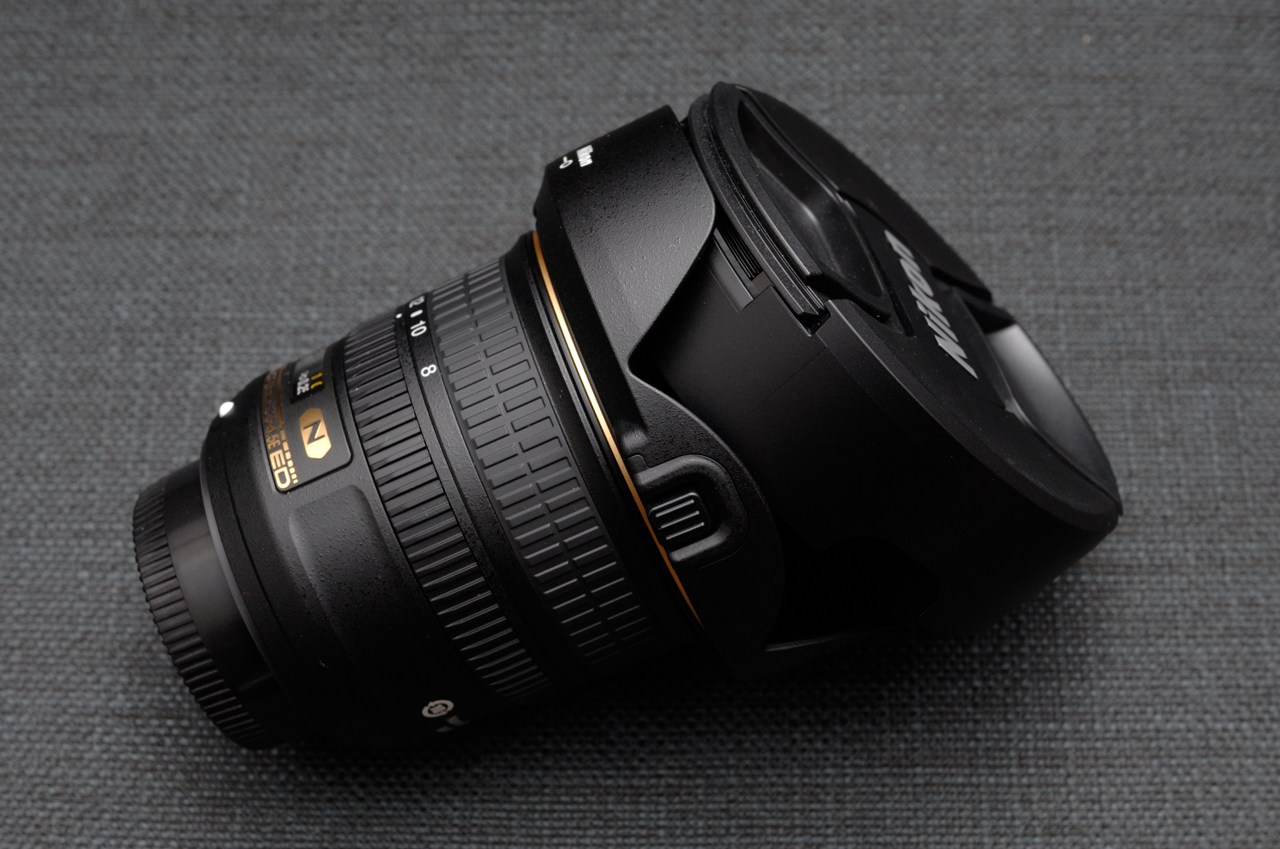
8-15mm with hood and cap
Like most of the recent lens introductions, this one also features an electronic diaphragm. Therefore the lens is not fully compatible with cameras before the D3/D300 generation of 2007.
On older cameras the diaphragm cannot be controlled and stopped down. Fortunately the optical quality is sufficient to use the lens wide open, which then makes it worthwhile to use the lens even on film cameras like the F90/N90.
The AF-S focus motor operates silently and quick. It is surprising that Nikon decided to include a full ring type motor. The lens elements that have to be moved are not that heavy and the focus throw is rather short.
Projection
The 8-15mm 3,5-4,5 can be used on FX as circular or diagonal Fisheye. On DX only the middle oft he zoom range makes any sense. Officially at 11mm the lens provides a diagonal Fisheye view on DX.

Corner darkening at 14mm on FX. 100% crop of corner.
Angle of view is 180 degrees on FX at 14mm or 175 degrees at 15mm. However, the 180 degrees at 14mm are a bit fake, as already darkening at the corners sets in at this focal length. On DX the situation is a bit better, the full 180 degrees can be enjoyed without limitations at 11mm and already at 10mm the lens covers the whole frame. At 9,5mm corner darkening sets in on DX.
Projection style is – typical for Nikon – orthographic.
Optical quality
Like with many recent lens introductions of Nikon the optical quality seems to be optimized for wide open performance. Nikon emphasizes this also in the marketing materials for this lens and I think that this is not just a marketing claim.
FX 15mm: Sharpness is excellent already wide open across the entire picture and into the corners at 36 MP FX. Stopping down does improve contrast and sharpness only slightly. Vignetting can be seen at f/4,5 and F/5,6, but disappears completely by f/8. CAs increase towards the borders and corners, but not above normal level and can be easily corrected.
FX 8mm: Also in circular projection mode sharpness and contrast are near perfect wide open. Stopping down increases sharpness and brightness at the border of the image circle.
DX 10-11mm: At 10mm (which is not the „official“ setting for diagonal projection on DX) the lens shows to be a tiny bit unsharp in the corners wide open, which is not detectable when stopping down to f/5,6. At f/11 the lens is sharp wide open across the frame regardless of aperture.
Due to the minimal focus distance of a bit less than 16cm from sensor pane, real care has to be taken no to touch anything with the front lens. The wide angle view overemphasizes the distance to any nearby object in the viewfinder, so better take care in close-up situations.
The 8-15mm is rather robust when it comes to flare and ghosting. It is perfectly possible to shoot directly into the sun. More problematic are bright light sources just outside the frame. In some situations a big reflection in the form of a bowl appears in the picture (see also the sample below).
Conclusion
A Fisheye lens is a specialized tool for a limited number of usage scenarios. Not every situation is suited to be pictured with a diagonal fisheye lens. However, in some cases a picture can take advantage of the fisheye effect or the distortion can barely be detected.
Much more limited is the use of a circular fisheye, which is most often used to create a quick 360 degree panorama with not too much effort. Here Nikon closes a gap in the lens lineup.
It is a highly individual decision to spend the rather expensive 1.500 € for this specialized lens. Professionals will be able to take the decision quite easily based on their own portfolio.
Amateurs will most likely be better off with one of the Samyang fix focal lenses, especially since the novelty of the fisheye effect wears off rather quick.
For everybody who can make use of a fisheye, there is no alternative to this lens. Build quality is good, weight and size are moderate and the optical quality is excellent.
Samples (DX): 9,5mm 10mm 11mm Sample for reflections
Samples (FX): f/4,5 f/5,6 f/8,0
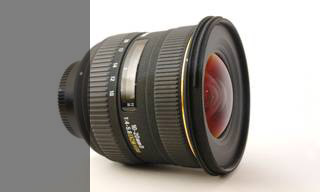
Sigma HSM 10-20 4.0-5.6 (DX)
The main reason to consider this lens is the extra 2mm gained at the wide end of the zoom range compared to the competition. For a wide angle the amount of CA is really low, distortion is moderate, too. The quiet HSM focussing motor is really nice to have and the built quality is good. The lens suffers from light falloff towards the corners but is really sharp throughout it´s range. Reports on the internet indicate that this lens suffers from sample variation, so it is better to buy it new from a store with a good return policy. Especially look for one-sided softness.
Samples (DX): 10mm f8 20mm f10
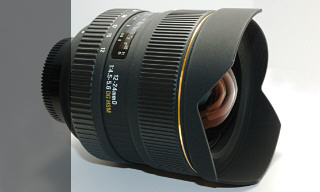
Sigma HSM 12-24 4.5-5.6 (Type 1)
The first and (to this date) only zoom that offers a field of view of 122 degrees at 12mm on film or FX. This Review deals with the first version of the lens.
Sharpness wide open is not very impressive, improves at f/5,6 at 12mm to reach a good level in the center of the frame with moderate performance at the sides. From f/8 and below the lens is sharp from corner to corner at it’s widest setting. With focal lengths beyond 20mm you have to stop down to f/11. Please keep in mind that this lens has a very pronounced field curvature which gets worse towards the 24mm end. It is best to focus manually to infinity, using he advantage of the huge depth of field.
Distortion is no problem with this lens at all, all lines remain straight even at the 12mm setting which is very surprising for this type of lens. People who shoot interiors will surely appreciate this.
Flare can be a problem due to the very bulbous front element. CA is more easily detected than with the 10-20mm but it is still on an acceptable level for an ultra-wideangle zoom. Backlit objects sometimes loose contrast and sharpness.
The 12-24mm has more contrast than the 10-20mm leading to pictures with more pleasant rendition.
If you plan to get a full frame (FX) camera in the future this lens is your only option if you want to go below 14mm with a zoom. If you can live with the need to stop this lens down into the f/8 to f/11 range it does a very good job on DX.
Samples (DX): 12mm f10 15mm f8
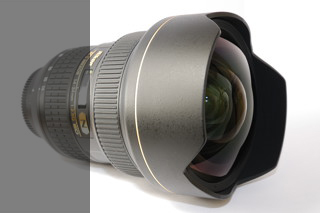
Nikon AF-S 14-24mm 2,8
A bulky lens with a weight of 1000g, equipped with a front lens like a fishbowl, which makes it impossible to mount filters. Does not sound attractive on first sight but all the shortcomings in handling are worth it. The lens designers at Nikon did not cut corners to achieve optical quality far beyond current lens designs. The lens is sharp from corner to corner even wide open at any focal length setting. And remember – we are talking about a super-wide lens here! Color and contrast are as good as it can get, compared to other lenses the 14-24 renders pictures a bit brighter. On DX format the lens is not used to its full potential but it still makes sense to use this lens instead of the wider 12-24mm lens offerings for DX just because the optical quality is so good and the ability to shoot at f/2,8 in dim places opens a new world of possibilities.
With the bulbous front lens flare becomes a natural problem that plagues all superwide lenses. Even when the sun is not in the frame small spots of flare can appear in the picture. Fortunately the flare spots are quite small. Don’t believe the the hype on the net that this lens has almost no flare because of the new nano-coating. This lens flares like any other wide angle (a bit less) but the flare spots are unusually small which then may be related to the new coating. I have tried a few wide angle zooms and this one is by far the best of the bunch.
Samples (FX / 36 MP): 14mm f/5,6
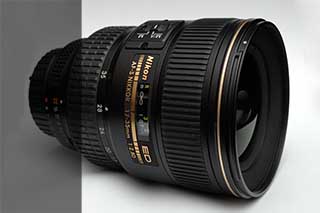
Nikon AF-S 17-35mm 2,8 D ED
The 17-35mm 2,8 has been in the Nikon portfolio since 1999 and is still available new from retailers (in 2017). However, many retailers do not stock it anymore and make it available on customer order. It can be assumed that Nikon does not produce the lens currently and does simply sell off existing stock.
One reason for the obvious low demand might be the relatively high price of 1.700 € compared to used lenses for around 700 €. A used purchase is more attractive based on the pricing, but also has its pitfalls. Also the much newer AF-S 14-24mm 2,8 is the more attractive option for many users.
Many used lenses are available based on the production volume of almost 150.000 lenses since 1999. Two serial number ranges are known, like for the AF-S 28-70mm 2,8. 1999-2006: 2xxxxx-3xxxxx and after switching to RoHS compatible materials 4xxxxx (2006-today). Approx. 110.000 lenses in the first range and 40.000 in the latter.
The build quality of the 17-35mm 2,8 is superb. Along with the DX 17-55mm 2,8 it is perhaps one of the best build wide or normal range zooms. The weight is rather moderate with 750g, the 14-24mm 2,8 weights a hefty kilogram.
The overall image rendering fits to the Nikkors of the 80s and 90s and represents an evolvement of the former AF-D 20-35mm 2,8. Sharpness wide open is good in the center of the from 17mm to 24mm and declines towards 35mm. At the same time aberrations increase, leading to blooming highlights and CA. Borders and Corners are not sufficiently sharp wide open, regardless of focal length.
Stopped down to f/4 sharpness increases overall, borders achieve a good level of sharpness at f/5,6 between 17mm and 24mm. To achieve a good level of sharpness in the corners, f/8 is needed in the wider focal range. However, there is still a trace of softness in the far extreme corners, but this should not impact general photography.
Between 28mm and 35mm filed curvature increases. For landscapes it is necessary to stop down to f/8 in order to achieve sharp borders.
CA are a bit stronger than with modern wide angles, especially towards the corners. Stopping down lessens the problem. Color rendering and contrast is similar to many older Nikkors, leaning to the cooler side. It fits very well to other professional zooms of the era, the AF-S 28-70mm 2,8 and AF-S 80-200mm 2,8. Obviously Nikon aligns the image characteristics amongst the professional lenses of one generation, which can also be seen compared to the successor generation 14-24/24-70/70-200.
The 17-35mm 2,8 renders smoother and more life-like compared to the apparently sharpness optimized 14-24mm and 24-70mm 2,8. This does not indicate however, that the 17-35mm is not sharp – far from that. It is more balanced in all image parameters, leading to a pleasing look with strong colors and contrast.
The 17-35mm is rather resistant to flare and ghosting. Reflections are very controlled, even shooting into the sun. Based on the construction it is naturally more resistant against light coming from the side than the 14-24mm 2,8. Nikon currently (2017) offers only the 17-35mm 2,8 and 14-24mm 2,8 as professional wide angle lenses with a constant aperture of 2,8. Both are differing in angle of view and practical aspects like the usage of filters, which is not possible with the 14-24mm. Also the differing focal ranges might make an important difference for picking either lens. For some the 14-24mm might be too short on the long end, but it offers a much better corner sharpness at the price of reduced flare resistance.
Other options include the semiprofessional 16-35mm 4,0 VR ED and the middle class AF-S 18-35mm 3,5-4,5 G ED. I do not have tested those two lenses, but the opinions on the 16-35mm 4,0 are differing when looking at other internet reviews. The newer 18-35mm G ED receives mostly positive feedback, especially based on sharpness.
A decision for any of the mentioned lenses is therefore not that easy. For photographers liking the rendering of the professional Nikkor lneses or needing the aperture of 2,8, there is no other option than 17-35 or 14-24. If only sharpness is the primary concern, the AF-S 18-35mm 3,5-4,5 G might be preferred.
Despite the rather high age of the optical construction, the 17-35mm 2,8 is still a solid pick in the year 2017. Image quality is overall very good, even on a 36 MP camera. Color and contrast are making up for the lack of sharpness in the corners (up to 24mm).
Leaves the question whether to buy the 17-35mm 2,8 new or used. This purely depends on the risk the buyer is willing to take. For sure a sample in like-new condition shall be selected when buying used, which is important because many professionally used lenses are available.
Preferred are also the lenses from the newer serial number range 4xxxxx, which are not very often offered. Lenses bearing this number range can only originate from the year 2006 or younger.
However, this is unfortunately not a way to prevent one of the most common failures with this lens – squeaking AF-S motor. All samples that I have seen so far suffer from this problem, even lenses from the newer serial number range. The AF-S motor squeaks after a longer period of non-use, which also could be as short as a few hours. In those cases the squeaking disappears after a few focusing cycles. In more severe cases the lens squeaks constantly and AF refuses to work after a few hours of storage until the focus ring is moved in both directions and across the focus limiter a couple of times.
It can be safely assumed that a new purchased lens, which does not squeak from the beginning, will develop the problem at some point in time. Many people relate the squeaking sound to a soon to be expected AF-S motor failure. This is not necessarily the case. There are numerous lenses which squeak for years and still have working autofocus functionality. Purchasing a new lens will provide some years of silent operation. On the other side two used lenses cost less than one new 17-35mm 2,8. Even a used lens plus the repair of a failed motor should cost less than a new lens – as long as Nikon stocks repair parts.
Samples (FX / 36 MP): 22mm f/8,0, 35mm f/2,8, 35mm f/4,0
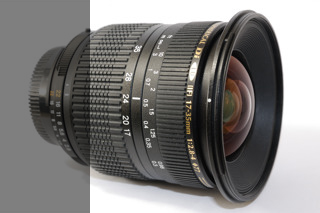
Tamron 17-35mm 2.8-4.0
This full frame capable lens is already discontinued by Tamron. A decision which might have been a bit early, given the new trend to FX cameras. Built quality is like every other Tamron: all plastic, reasonably sturdy while still being light enough to be carried everywhere.
On the D200 the lens delivers a good optical performance with a few quircks in handling. At the wide end the wide open performance is already quite excellent, at least in the center portion of the frame. At the 35mm end wide open performance drops a bit and stopping down is recommended. Field curvature is a problem with this lens. It becomes apparent at the wide end leading to unsharp corners up to f/5,6 if the lens is not focused properly to infinity. In order to avoid the problem either zoom in to 35mm, focus on a far away object and zoom back out or focus manually right away. The focus pane will be further back and the corners will be sharper. For good corner performance on DX stop down to at least f/5,6 across all focal lengths. Overall color and tonality is quite pleasant and leaning to a warmer tone without having a disturbing color cast. On the Nikon 12MP FX sensor vignetting is visible at the wide end. At 17mm it is easily detected up to f/5,6. The situation eases with increasing focal length and is not a problem any more from 24mm and up. At the wide end smeared corners are problematic up to f/5,6 and for good results you have to stop down to f/11 at 17mm. However, even at f11 corners can get a bit smeary at the extremes, depending on the shooting situation. As expected corners get better as the focal lengths increases. Already at 20mm the corner situation improves pretty much.
Samples (FX / 12 MP): 17mm f11 17mm f11 22mm f11 35mm f11
Samples (FX / 36 MP): 17mm f/8 32mm f/8
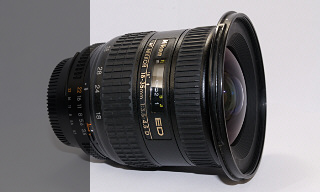
Nikon 18-35mm IF-ED 3.5-4.5
Nikon introduced this lens as a cheaper alternative to the Nikkor 17-35mm 2,8 in 2000. The lens itself is not quite big, but at the front section the lens features a 77mm filter thread that is quite large. The lens retails for more than 500 Euro and the built quality you get for that price is a joke. The lens is very light (370g), which is no fault in itself, but the lens feels and handles like a plastic toy. Nikon surely needs to have a look at the competition which can produce lenses with very good built quality at much lower price points. The focus throw is quite short, leading to a very fast focus operation. The focus ring moves freely without any resistance at all, so manual focus is not recommended.
The optical quality on the DX sensor of the D200 is average. At the wide end it produces sharp pictures with very good, neutral colors. Sharpness declines moderately towards 35mm but is still on an good level. Field curvature is not a huge problem (but detectable on DX) with this wide angle, it is therefore better suited for landscape photography than the Tamron 17-50mm. In general it seems to be diffraction limted already at f/11. Optimal performance on a DX sensor is achieved at f/8 throughout the range. Distortions and a tendency to flare are big problems with this lens. At the wide end barrel distortion is much more prominent than with the Tamron 17-50mm 2,8 at the same focal length setting, I would not recommend this lens for architecture photography at all.
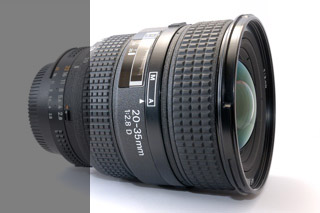
Nikon 20-35mm 2,8
Nikon’s professional wide angle of the nineties unifies all characteristics that you would expect from such a lens: Excellent build quality, good optics and a (originally) high price tag. The price in Germany in 1998 was around 3500 DM, US about 1600 $. From 1993 to 2000 around 45.000 lenses were produced.
The importance of this lens and the absolute optical performance have to be seen in context with the wide angle lens development at Nikon during the 80’s and 90’s.
Since the last wide angle zoom by Nikon, the AI-S 25-50mm 4,0 ran out in 1985 there was a huge gap in the lens lineup. No professional zoom started wider than 35mm and the 24-50mm 3,5-4,5 zoom was just a mediocre performer. So, in 1993 this lens must have filled a big demand among professional photographers.
Unlike the successor 17-35mm 2,8 ED this lens lacks ED-glass and is being driven through screw drive AF. The build quality is superb. Some years ago I obtained a sample with fungus for cheap in the hopes of being able to repair it. Obviously it was all too late for this lens, as the fungus caused the left side of the frame to be washed out and I was not able to remove it. Some years later I am now on my second sample, which is is in perfect shape.
Therefore I decided to take the fungus-plagued lens completely apart just for fun. What I saw eclipsed the build quality of many AI and AI-S lenses that I “serviced” before. But even without taking it apart you can tell that this lens is build like a tank. The weight, the haptic caused by the crinkle finish and the fact that nothing has the slightest amount of play causes quite a satisfactory feeling when picking up this lens. I found many posts on the internet of the late nineties that criticize the weight of the lens, which is just 585g. Obviously people didn’t know what was coming from 1999 on.
One thing that puzzles me a bit is the lens hood HB-8. It does the job like on any other wide angle and is even padded with felt on the inside. But this is the only Nikon bayonet hood that I know of that not clicks into place. You simply turn it until it sits in position.
The picture quality as a whole is very good if not excellent, but there are some aspects where the age of the lens manifests itself.
First the positive aspects: Colors and contrast are very good. Image rendering is very close to the AF-S 28-70mm with strong colors. CA is not that of an issue on the D700, however the internet is full of reports about CA being a problem on film and older sensors. Sharpness in the center is very good even wide open at all focal lengths. Wide open purple fringing can appear around highlights which disappears completely by f/4.
Corner sharpness is the biggest problem. From f/2,8 to f/5,6 at the wide end the corners are not simply unsharp – they are smeared. At f/8 corners get usable and at f/11 they are perfect. Between 24mm and 35mm you can get away with f/8 under the right conditions.
The problem in the corners is not unusual for wide angles around 20mm on full frame. For sure the successor 17-35mm 2,8 is better and the 14-24mm 2,8 lets you forget that smeared corners and wide angles did go hand-in-hand for decades.
But to put the severity of the problem into perspective: The Tamron 17-35mm also needs f/11 to achieve sharp corners at the wide end. But then there is still a kind of softness present in some shooting situations, whereas the 20-35mm 2,8 is good in any case.
As a budget alternative or supplement to a specialist lens like the 14-24mm 2,8 the 20-35mm is highly recommended. Compared to the Tamron 17-35mm the 20-35mm offers an overall more pleasing image quality with better colors and contrast.
Given the price level on the used market it is tough to decide if the Nikon Af-S 17-35mm 2,8 is the better choice. For most people it will be, since the successor offers AF-S and 3mm more on the wide end. For me this lens works very good as supplement to the 14-24mm 2,8 when I need slightly longer reach. A deciding factor can also be the quite common AF-S motor failures of the 17-35mm 2,8 which lead to a major repair. The quite fast screw drive of the 20-35mm will last very long – or until Nikon decides to drop the in-camera motor entirely.
Samples (FX / 36 MP): 24mm f/8